
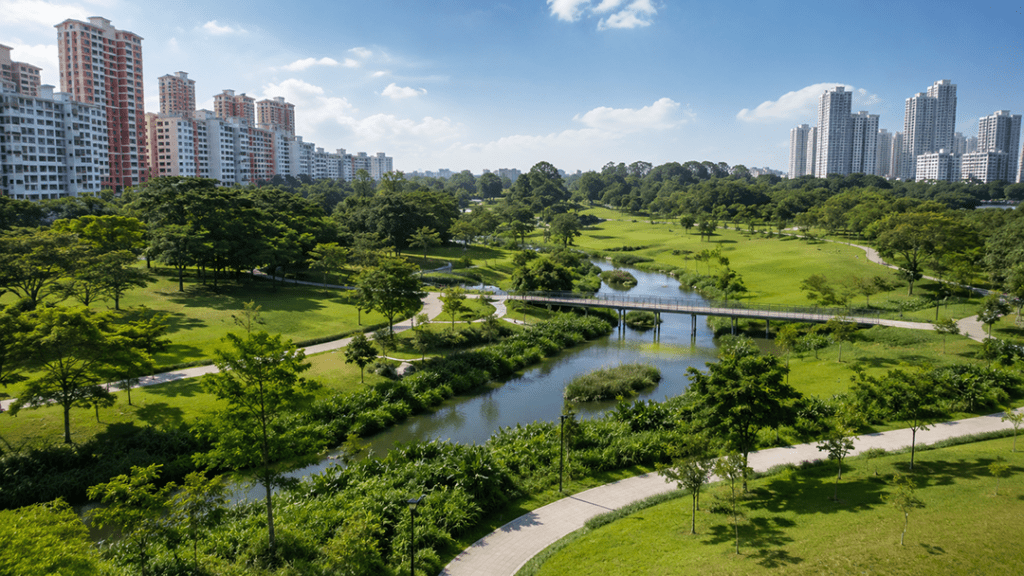
In Landform Feng Shui, buildings give strength while nature brings calm. When both are balanced, the environment becomes more stable, liveable, and supportive.
A good environment is not only about direction, stars, or formulas. Before all that, we must first look at the landform.
Landform Feng Shui is about how the surroundings support the people living or working there. It looks at buildings, roads, open space, trees, landscape, water, movement, and how Qi gathers.
A good place must have balance.
Too much Yang energy can make a place feel hard, busy, stressful, and restless. Too much Yin energy can make a place feel slow, quiet, passive, and lacking in drive.
Singapore is a good example of balance.
As a country, Singapore is modern, structured, and active. We have tall buildings, roads, ports, airports, business districts, MRT lines, and constant movement. These are Yang qualities.
But Singapore is also a garden city. We have trees, parks, plants, water features, green corridors, and well-planned landscape. These bring Yin energy. They soften the hard structures and make the environment more liveable.
This is why Singapore has a special Feng Shui quality.
It has the strength of a modern city, but also the softness of a garden.
The buildings give structure.
The roads create movement.
The greenery brings calm.
The landscape allows Qi to settle.
This same principle applies to property.
For condominiums, a good project is not just about the block, the unit, or the facilities. It is also about the land around the buildings. A project with only buildings, carparks, driveways, and hard surfaces may feel too Yang. The energy becomes tight and pressured.
But when a project has space, trees, gardens, pools, courtyards, and proper landscape, the Qi becomes more balanced. The environment feels softer, calmer, and more complete.
This is why some older large projects can still feel pleasant after many years. They may not be new, but they have space, greenery, and a stronger internal environment. Projects such as Laguna Park, Maple Woods, The Arcadia, and Hillcrest Arcadia show this kind of landform quality in different ways.
Of course, property value is still affected by many things — location, age, lease, size, MRT access, renovation, market timing, and buyer demand. Feng Shui does not replace market study.
But Feng Shui helps us understand why some projects simply feel better to live in.
Smaller single-block projects often face a different challenge. Many have limited land, less landscape, fewer open spaces, and less room for Qi to gather. The building may be new and efficient, but the project may not have enough “body” to hold energy well.
The same applies to landed homes.
In a landed property, the house is Yang. The walls, roof, car porch, driveway, tiles, concrete, gate, and built structure all carry Yang energy.
The garden is Yin.
The trees are Yin.
The plants are Yin.
The soil and open space are Yin.
A good landed home needs both.
This is why Good Class Bungalows often feel different. Not only because they are large or expensive, but because the house has space around it. There is garden, greenery, shade, and room for Qi to breathe.
In Singapore, a smaller house on a larger plot is usually not a problem. In fact, it can be a strength. The real issue is when the house becomes too big for the land.
This is common in modern landed homes. Owners extend the house, cover the front, build up the back, cement the garden, remove trees, and try to maximise every inch.
But in Feng Shui, not every empty space is wasted space.
Some empty space is needed for Qi to gather.
Some garden space is needed for the house to breathe.
Some trees are needed to soften the form.
When a landed home becomes too built-up, the energy becomes too Yang. The house may look bigger, but the Qi becomes tight, dry, and restless.
More built-up area does not always mean more abundance.
Sometimes, it means more work, more pressure, more expenses, and less ability to truly accumulate.
That is why landform matters.
A good property is not just about how much space you build. It is about how well the building and the land work together.
The structure gives strength.
The landscape gives balance.
The open space allows Qi to gather.
When Yin and Yang are balanced, the property feels more stable, more liveable, and more supportive.
That is the real foundation of good Landform Feng Shui.