
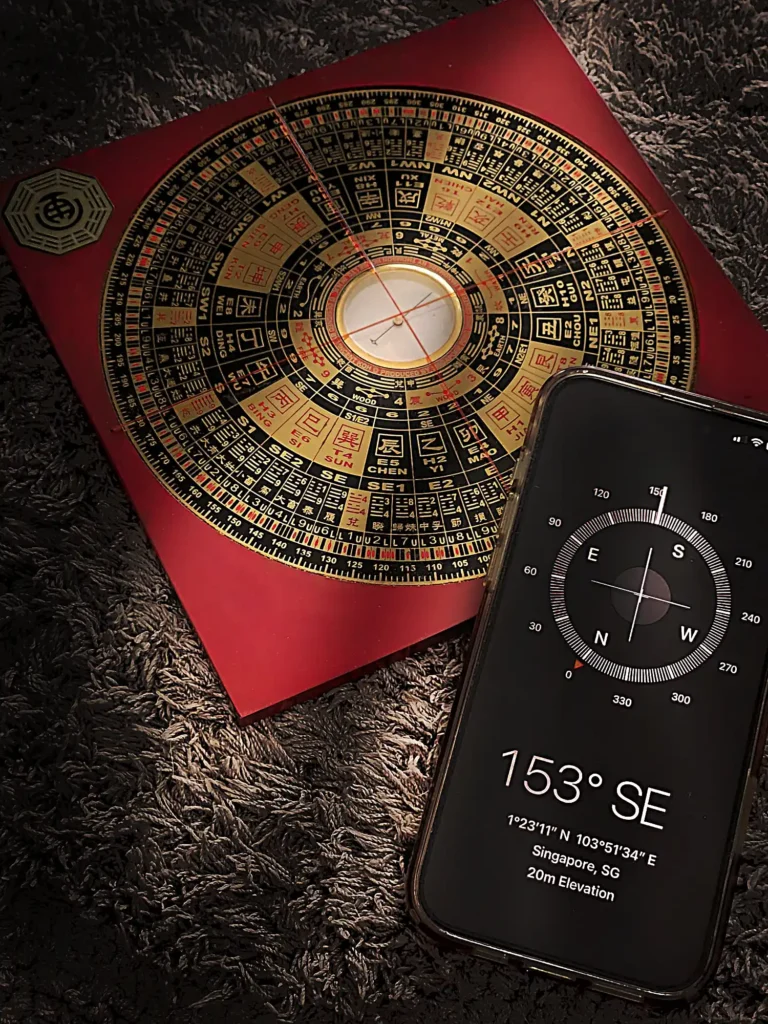
Why Accuracy Still Matters in Feng Shui
Today, Feng Shui tools are everywhere.
There are phone apps, digital compasses, instant BaZi charts, online calculators, and even digital Luo Pan tools that promise to give you a reading within seconds. One tap, and the result appears on the screen.
It looks easy. It feels modern. And for many people, it gives the impression that Feng Shui has become simple.
But this is where the danger begins.
Convenience is not the same as accuracy.
In Feng Shui, especially Flying Star Feng Shui, accuracy is not a small matter. A few degrees can change everything. A digital compass may vary by three to five degrees, sometimes even more, depending on the phone, the surrounding metal, nearby electrical interference, or how the reading is taken. To most people, three degrees may sound like nothing.
In Feng Shui, it can be the difference between one house chart and another.
Those few degrees can shift a property into a different mountain. Once that happens, the entire Flying Star natal chart changes. What first appears to be a strong house may no longer be strong. What looks like a good wealth formation may not exist at all. A property that seems usable on paper may become difficult, weak, or even problematic when measured properly.
This is why I do not treat compass readings casually.
One of the biggest mistakes I see today is when practitioners ask clients to stand at the door and take a compass reading with their phone. Let me be very direct. This is not a small mistake. It is a serious one.
A house facing is not something you casually point and shoot.
First, the true facing must be identified. It is not always the main door. In some properties, the facing may come from the most active side, the widest opening, the strongest Yang movement, or the direction where Qi is received. After that, the reading must be taken from the correct reference point. Magnetic interference must be avoided. Several readings must be taken and compared. The surrounding form must be understood. And most importantly, the practitioner must know whether the property sits close to a boundary line.
A phone cannot judge all this.
And a client, no matter how careful, is not trained to detect these details.
This matters because once the first reading is wrong, everything that follows becomes wrong. The Flying Star chart will be wrong. The analysis will be wrong. The advice will be wrong. The remedy may also be wrong. At that point, it is no longer Feng Shui. It is guesswork dressed up as Feng Shui.
I once assessed a house where the initial reading was taken using a digital Luo Pan app. On paper, the chart looked excellent. It showed strong wealth potential, good combinations, and a layout that seemed supportive.
But when I stepped into the house, something felt off.
The energy was heavy. Dull. Unresponsive.
That feeling matters. After many years of audits, you begin to sense when the chart and the house do not agree. The paper may say one thing, but the Qi in the house tells another story.
So I measured the property again, properly, on site, using a traditional Luo Pan.
The result was very different.
The house was sitting exactly on the borderline between two mountains. In this type of case, the normal chart may not apply. A substitute chart must be considered. This is a critical detail, and it can completely change the reading of the house.
No app would have caught that reliably.
If the buyer had relied only on the first digital reading, they would have moved in expecting growth, support, and improvement. But over time, they may have experienced the opposite — not because they were unlucky, but because the foundation of the audit was measured wrongly from the start.
This is why tools do not replace experience.
Feng Shui is not just about reading numbers from a screen. It is about judgment. It is about knowing when a reading is stable and when it is not. It is about knowing when a chart can be used and when it must be questioned. It is about understanding how landform, layout, facing, internal use, external environment, and time all affect the quality of Qi.
That kind of judgment cannot be automated.
It also cannot be outsourced to a client holding a phone at the main door.
This does not mean digital tools are useless. They can be helpful for rough reference. They are fine for general direction checks, early-stage curiosity, or a quick sense of orientation. But they should never be treated as the final authority when making a serious Feng Shui decision.
A calibrated Luo Pan, proper on-site measurement, and real audit experience still matter.
In Feng Shui, there is very little room for guessing. The smallest mistake at the beginning can affect the entire outcome. A few degrees off, and the house chart changes. The wrong chart leads to the wrong conclusion. And the wrong conclusion can lead a person to buy, renovate, move in, or activate the wrong part of the house.
That is why I always say this clearly.
Do not rely on convenience when accuracy is required.
Do not rely on guesswork when the decision involves your home.
And definitely do not rely on a casual phone reading when the result can affect the entire Feng Shui assessment of the property.
Technology is useful. It makes information easier to access. But in Feng Shui, ease of access does not mean depth. A tool can show numbers, but it cannot replace the trained eye, the proper method, and the experience to know when something does not add up.
Most people rely on what is easy.
I focus on what is accurate.
Because in Feng Shui, the first reading is not just a small technical step. It is the foundation of the entire audit. If the foundation is wrong, everything built on top of it will be wrong as well.
And sometimes, the smallest detail at the start can change everything that follows.