After understanding that luck is not fully within our control, the next question becomes even more important. If we cannot control every outcome in life, then we must be more careful with the areas we can influence. One of the biggest decisions within our control is the home we choose to live in.
A home is not just a place to sleep, eat, and keep our belongings. It is the environment that surrounds us every day. It affects how we rest, how we recover, how we think, how we communicate, and how we make decisions. Over time, the quality of the house begins to shape the quality of life inside it. This is why, before choosing a property, the question should not only be whether the house looks good, whether the price is right, or whether the location is convenient. The deeper question is whether the house can hold the people living in it.
In Feng Shui, a house must be able to hold Qi. Qi must be able to enter, move, gather, and settle. If the Qi is too weak, the occupants may struggle to progress. If the Qi is too harsh, they may feel constant pressure, conflict, or instability. If the Qi is scattered, life becomes harder to hold together. A house that looks attractive on the surface may still fail to support the people inside if the energy cannot settle properly.
This applies not only to homes for own stay, but also to investment properties. Some of my clients engage me to assess investment units, and when I ask them why, their answer is always practical. If the house cannot even hold the tenant’s life together, how can it hold the landlord’s rental income?
It may sound unusual at first, but the logic is simple. If a tenant stays in a house with poor Feng Shui and their life becomes unstable, the tenancy may also become unstable. Work issues, financial pressure, poor health, relationship problems, or sudden life changes can cause the tenant to move out earlier than expected. For the landlord, this means more vacancy, more turnover, and more uncertainty. From this point of view, Feng Shui is not only about energy. It is also about stability. A house that can hold a person can hold a tenant. A house that can hold a tenant can also hold income.
For own stay, the matter becomes even more important because the effect is personal. Beyond location, schools, amenities, transport, view, and layout, the buyer must ask whether the house can support the life that will take place inside it. Not all houses are the same. Some houses support wealth. Some support health. Some support relationships. Some support career growth. Some look beautiful, but slowly drain the people living inside. Unless you are building a house from scratch, you are not creating energy from a blank canvas. You are choosing from what is already available.
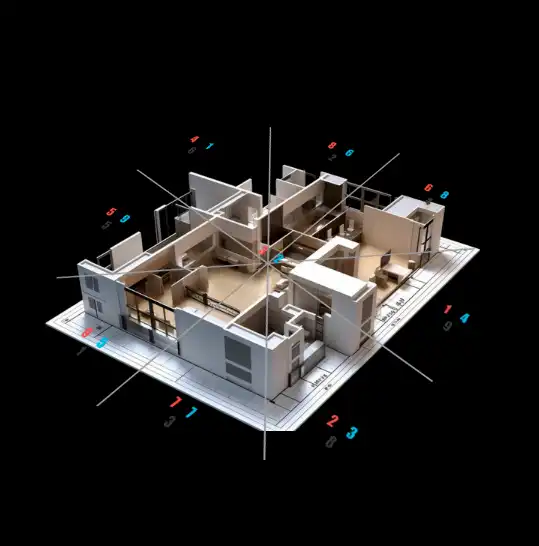
In Flying Star Feng Shui, every house has nine sectors. A proper assessment does not simply label a house as good or bad. It studies how much of the house is truly usable and supportive. In my own evaluation, a house that is around fifty percent usable is only average. Around sixty percent becomes acceptable. Around seventy percent is good. Anything too far below that will usually cause the occupants to feel the strain over time. The house may still be livable, but it does not truly support life.
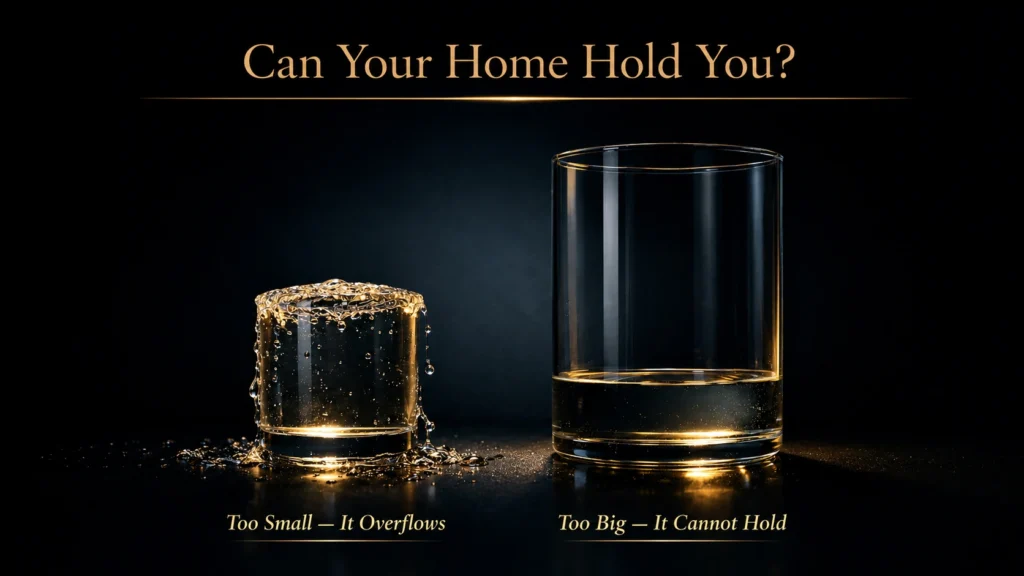
This is where size, proportion, and flow become important. A house that is too small for the people living inside can create a sense of pressure. The Qi becomes compressed because there is not enough room for movement and circulation. When energy cannot move, pressure builds. Stress increases. Patience drops. Small issues become bigger than they should be. Over time, the mind feels crowded, and the body does not fully relax.
This does not mean that a small house is automatically bad. In Singapore, many people live well in compact apartments because the space is planned carefully and used properly. The real issue is not size alone. The issue is whether the house has enough room for Qi to circulate, and whether the layout allows the occupants to live, rest, and recover without constant pressure. When the space is too tight for the needs of the family, the house does not support growth. It contains the people inside, but eventually it may also constrain them.
The opposite problem can also happen. A house that is too large for the number of people living inside can feel empty and scattered. This is often seen in large landed properties where the space is impressive, but the life inside the house is weak. When too few people occupy too much space, the Qi may not gather properly. The house feels quiet, cold, and less alive. Maintenance issues may appear more often. Things may spoil more easily. Rooms may remain unused, and over time, the energy of the house starts to drift.
This can affect the people living inside. Energy drops. Recovery slows. Family members spend less time together. The house may not create open conflict, but it can create distance. People begin to live separate lives under the same roof. There is less warmth, less interaction, and less connection. This is what scattered Qi does. It does not always break things suddenly. It quietly loosens the bond between the house, the people, and the life they are trying to build.
The goal is therefore not simply to buy the biggest home one can afford, nor is it to accept a cramped home just because it is practical. The goal is balance. A good house must have enough space for Qi to move, but not so much empty space that Qi cannot gather. It must allow energy to circulate and settle. When this balance is present, the home feels more stable. People rest better, recover faster, think more clearly, and relate to one another with less strain.
In Singapore, this principle can be seen clearly across different property types. A high-rise condominium should not be assessed in the same way as a landed house. In a landed property, the main door often connects directly to external Qi from the road, garden, open space, or surrounding landform. The entrance is usually more active because it has a direct relationship with the outside environment.
In most high-rise condominiums, the situation is different. The main door often opens into an enclosed internal corridor, similar to a hotel walkway. This corridor may be clean, bright, and well-designed, but it usually has limited contact with natural external Qi. There is little air movement, little openness, and very little connection to the surrounding landform. Because of this, the main door may not always function as a strong mouth of Qi in the same way as a landed house.
This becomes even more important in smaller condo units. In daily life, most owners keep the main door closed almost all the time for privacy, security, noise control, and air-conditioning. As a result, the entrance is not actively bringing in Qi throughout the day. When the door is closed, the corridor is enclosed, and the unit is compact, the flow of Qi becomes more restricted. The home can start to feel blocked or stagnant, especially when the internal layout does not allow energy to move smoothly.
This is one of the most overlooked issues in high-rise condo Feng Shui. Many buyers assume that the main door is always the main source of energy because traditional Feng Shui often places strong emphasis on the entrance. But in modern condo living, the practical use of the space must be considered. If the main door is closed most of the time and opens into an enclosed corridor, then the actual usable Qi may be coming from somewhere else.
For many high-rise units, the balcony, windows, external frontage, and view become extremely important. They may become the true source of usable Qi for the home. A unit with wider openness, stronger external frontage, better airflow, and a clearer view can often perform better than another unit in the same development where the Qi is trapped or restricted. This is especially true for one-bedroom and two-bedroom units, where the internal space is limited and the margin for error is smaller.
This does not mean that every small condo unit is unsuitable. It simply means that the selection must be more precise. When the entrance is weak, the corridor is enclosed, and the unit is compact, the layout must be assessed with greater care. The placement of the living area, bedroom, balcony, kitchen, and key sectors becomes even more important because there is less space to correct a poor flow of Qi after purchase.
Landed properties offer a different kind of potential because they usually provide more control over how Qi enters and moves. A detached house, for example, has open space around it and can receive energy from more directions. A semi-detached house has less freedom, while a terrace house is more restricted because it is attached on both sides. In general terms, the more open the property, the more potential there is for Qi to circulate.
However, this does not mean every detached house is good, or every terrace house is weak. A well-selected terrace house can still perform better than a poorly configured detached house. Structure creates potential, but the final result still depends on selection, facing, landform, layout, and how the house is used. In Feng Shui, the size of the house does not automatically decide the quality of the Qi. The way Qi enters, gathers, moves, and settles is what matters.
In high-rise developments, the same principle applies. Two units in the same block can perform very differently. One unit may have a wider view, better external frontage, stronger Qi, and a more supportive internal layout. Another unit, only a few floors away or facing a slightly different direction, may feel more enclosed and restricted. This is why a buyer should never assume that all units in a good project are equally good. The development may be attractive, but the block, stack, facing, layout, and sector usage still decide whether the unit can truly support the people living inside.
The internal layout is just as important. The placement of the main door, bedrooms, kitchen, balcony, toilets, missing corners, and key sectors can change how the house performs. A good facing may be weakened by poor internal usage. A decent house may be improved if the right rooms are used by the right people. In Feng Shui, the house is not judged only by how it looks. It is judged by how energy enters, where it gathers, which sectors are activated, and who is affected by those sectors.
This is why a proper pre-purchase evaluation matters. Before buying, the buyer still has a choice. If the unit is unsuitable, the buyer can walk away. If the project is average, better stacks may still be identified. If the house has potential, the buyer can understand how to use it correctly. But after purchase, the options become limited. Remedies may help, but they cannot always correct a poor structure or a badly selected home.
A house that can hold you does not need to be perfect. Very few properties are. But it must have enough supportive energy to sustain the people living inside. It should not constantly drain health, disturb relationships, weaken career progress, or create repeated pressure. It should give the occupants a stable base from which they can grow.
The right home does more than provide shelter. It holds your energy, your plans, your recovery, your relationships, and your future decisions. It allows Qi to circulate and settle. When that happens, life does not become free from all problems, but it becomes easier to manage. Effort produces better results. Rest becomes deeper. The family feels more grounded.
Before choosing a home, do not ask only whether the house is beautiful, convenient, or within budget. Ask whether it can support the life you want to build. Ask whether the Qi can enter. Ask whether it can move. Ask whether it can gather. Ask whether the house can truly hold the people living inside it.
Because a house that can hold you is not just a property.
It is a foundation.
Request a Pre-Purchase Feng Shui Evaluation before you decide.