Or When You Work Against the House
Some homes drain wealth, health, and relationships — slowly, quietly, and often unnoticed.
But here’s the part most people never consider:
Is it the house working against you…
or are you unknowingly working against the house?
Buying a home is usually approached as a logical decision. Price, view, location, and layout are the main factors most buyers consider. These are important, but they do not determine how a home will actually affect the people living in it over time.
What is often overlooked is something less visible — the environment itself.
Every home carries energy. In Feng Shui, this is known as Qi. This energy interacts with the occupants daily, influencing how well they rest, how clearly they think, how relationships develop, and how life progresses.
When the environment supports the individual, things tend to move more smoothly. Effort produces results, and progress feels natural. When it does not, even simple things begin to feel more difficult.
A home is not just a physical structure. It is an environment that continuously interacts with the people inside it.
Feng Shui is often misunderstood as belief or decoration. In practice, it is neither. It is a way of understanding how an environment affects outcomes.
Many established organisations recognise this. Large corporations, developers, and institutions incorporate Feng Shui considerations into planning and design — not out of superstition, but because it has observable effects.
In cities such as Singapore and Hong Kong, this is common. Developments are assessed before construction, and buyers avoid certain units despite attractive pricing.
In Singapore, this can be seen clearly in how different types of properties are approached.
High-density developments in areas such as Marina Bay or Shenton Way are often designed with efficiency and land optimisation as the priority. These projects maximise space, views, and accessibility.
In many of these units — especially one- and two-bedroom layouts — the primary source of Qi comes from the balcony. This becomes the main entry point for external energy.
The main door, on the other hand, typically opens into an internal corridor, similar to a hotel walkway. These corridors are enclosed, with little or no connection to external Qi. As a result, the inflow of energy from the entrance is limited.
This does not mean such units are unsuitable. But it does mean the overall structure restricts how energy can enter and circulate within the home.
Because of this, the margin for error is smaller.
When the structure is already constrained, the internal layout becomes even more critical.
In contrast, landed properties — particularly detached houses — offer far greater control.
With open space on all sides, energy can enter from multiple directions and move more freely throughout the home. This flexibility makes it easier to align the property with favourable energy patterns.
This is why, in general terms, a detached house tends to perform better than a semi-detached house, and a semi-detached house better than a terrace house.
The difference is not just size — it is the level of control over how energy flows.
That said, this is not absolute.
A well-selected terrace house can still outperform a poorly configured detached house.
Structure creates the potential.
But the outcome still depends on how the property is selected and used.
In high-rise developments, the same principle applies.
Units with greater openness — wider views, more external frontage — tend to allow Qi to circulate more freely. Units that are closely enclosed, with limited external exposure, often experience more restricted flow.
Beyond this, the internal configuration remains critical.
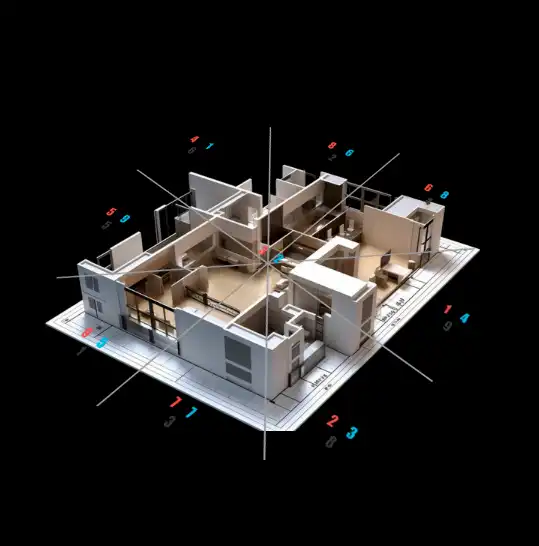
The placement of rooms, the distribution of space, and how the layout interacts with the overall facing can significantly influence how energy is experienced within the unit.
Even within the same block, these differences can lead to very different outcomes over time.
At its core, Feng Shui is environmental strategy.
A space either supports life, or it gradually drains it.
There are several forces that influence life outcomes — fate, luck, education, and environment. Not all of these can be controlled, but the environment is one factor that can be chosen.
When the energy within a home flows well, it supports stability and growth. When it is blocked, misaligned, or untimely, problems begin to appear.
These effects are rarely immediate. They develop gradually, which is why they are often overlooked.
A house that works against its occupants does not usually feel wrong at the beginning. In many cases, it may appear comfortable or even ideal.
Over time, however, patterns begin to emerge.
Health becomes harder to maintain.
Relationships experience more tension.
Financial progress feels inconsistent.
Stress increases without a clear reason.
These patterns are not random.
In Flying Star Feng Shui, they are linked to how energy is distributed within the home, and how that energy changes over time.
Favourable energy can weaken.
Unfavourable energy can become active.
Timing plays an important role. What appears suitable at one point may not remain so indefinitely.
After years of practice and numerous property evaluations, it becomes clear that accurate assessment depends on understanding both structure and timing.
This is where Flying Star Feng Shui is particularly relevant.
It explains how energy shifts across different periods, how it interacts with the layout and orientation of a property, and how these changes affect various aspects of life.
It can indicate when conditions for wealth are stronger or weaker, why certain relationship patterns develop, and how specific areas of a home may influence health or stress.
Rather than relying on general interpretation, it provides a structured way to evaluate how a property is likely to perform over time.
Even within the same unit — the same stack, the same layout, and the same facing — outcomes can still differ.
Because it is not only the house that matters, but how the house is used.
Activating the wrong energy within the same unit can still produce negative results.
The placement of the bed, its direction, and its position within the room can influence rest and long-term health.
A study table placed in a different location can affect focus, clarity, and decision-making.
Even small changes in how space is used can activate different sectors of the home — leading to very different outcomes over time.
What appears to be the same unit can behave very differently, depending on how the energy is engaged.
Most people only consider Feng Shui after problems have already surfaced. By then, the impact has already been felt, and solutions are often more limited.
A more effective approach is to evaluate the property before making a commitment.
This is not about fear or superstition. It is about awareness — understanding the environment clearly before making a long-term decision.
Choosing a home is one of the most significant decisions a person will make.
It should not be based solely on what looks good or feels right in the moment.
It should be based on whether the environment is able to support the life that follows.
Before committing to a property, it is worth understanding how it will affect you over time.