
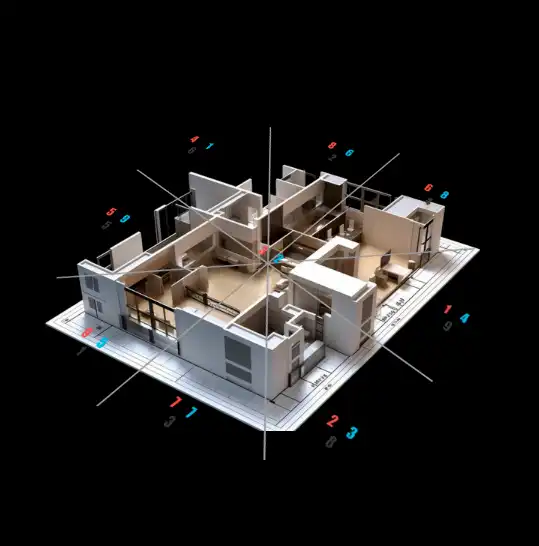
Two units in the same block can still behave very differently. They may share the same general facing and look almost identical from the outside, but once the Flying Star chart is mapped onto the actual unit, the internal layout changes everything.
A 3-bedroom and a 5-bedroom unit may face the same direction, but the placement of rooms, doors, kitchen, toilets, study area, balcony, and master bedroom can fall into very different energy sectors. That is where the outcome begins to change.
One unit may place the master bedroom in a supportive sector, while another may place the kitchen or toilet in a problematic sector. One layout may allow Qi to flow smoothly through the home, while another may trap, block, or disturb the movement of Qi. So from the outside, the two units may look almost the same. But from the inside, they can behave very differently.
In one home, life may feel smoother. Progress comes with less resistance. Health, relationships, and wealth can be better supported. In another home, the same effort may produce slower results. Stress may build quietly. Opportunities may come, but they are harder to hold.
That is why Feng Shui cannot be judged by facing alone. Facing gives us the chart, but the layout tells us how that chart affects real life.
Most buyers evaluate a property based on what they can see — price, location, size, view, layout, and design. These are important factors, but they do not fully determine how the home will perform over time. What is often overlooked is how the space receives, holds, and circulates Qi. This is where the real difference begins.
In landed properties, this principle is even more important because each level may not behave the same way. The ground floor includes the garden, porch, entrance area, backyard, and open external space. These areas affect how Qi enters, gathers, and moves through the home.
But the second floor is different. It does not include the garden or backyard in the same way. The upper floor has its own layout, with different rooms, windows, balcony positions, staircase connection, toilets, and bedrooms. Once the Flying Star chart is applied to that level, the usable sectors may change in practical effect.
So even within the same landed house, the first floor and second floor can produce different Feng Shui outcomes. The facing of the house may remain the same, but the way Qi is received and used on each floor is not the same. A living room downstairs may enjoy open space and better circulation, while a bedroom upstairs may fall into a very different energy sector without the support of the garden or backyard.
This is why a landed property cannot be judged only by its overall facing or external form. Each level must be studied according to how the space is actually used. The ground floor may support movement and activity, while the upper floor may affect rest, health, relationships, and personal stability in a very different way.
The same principle applies to condominiums, although it is less obvious. In many modern developments, especially in central areas such as Shenton Way and Marina Bay, units are often designed with one main opening, usually the balcony. This becomes the main source through which Qi enters the home. The main entrance, on the other hand, is often located along enclosed internal corridors. These corridors are usually long, sheltered, and similar to hotel hallways, with very little natural movement of air or energy.
As a result, circulation within the unit becomes limited. Qi enters mainly from one side, but may not have enough pathways to move, settle, or disperse properly. Over time, this can lead to stagnation.
When circulation is restricted, the effects are rarely immediate. They usually develop slowly. Movement slows. Opportunities become harder to sustain. The overall environment begins to feel less supportive. The occupants may still work hard and make the right effort, but the results may feel harder to secure.
This is when a house starts working against its occupants — not in a dramatic way, but in subtle and consistent ways that accumulate over time.
From a property perspective, these patterns are often reflected in market performance. Some units may appear attractive at first because of location, design, or view, but over time, resale demand can weaken. Certain stacks may take longer to sell. Some layouts may underperform compared to others in the same development. This is not always purely due to market conditions. In many cases, it is closely linked to how the building is designed and how effectively Qi is able to flow within the unit.
With experience, these patterns become clearer. Some developments consistently perform well. Others face recurring challenges. Some blocks within the same project do better than others. Some units move easily in the market, while others require more effort despite looking similar on paper.
The difference lies in how the space functions beyond what is immediately visible.
Choosing a property, therefore, cannot rely on surface-level comparison alone. Two units may share the same block. They may share the same facing. They may even look equally attractive. But they may not support the occupants in the same way.
The objective is not just to select a property that looks good, but one that performs well — one that supports the people living in it, allows Qi to move properly, and helps life progress with less resistance.
Because when the flow within a home is right, everything else becomes easier to sustain.
Before you commit, it is worth understanding what you are really choosing.